Product Backlog Refinement with AI: Tools and Techniques
Use AI to refine Product Backlog items: expose ambiguity, split work, draft acceptance criteria, and check dependencies, while keeping decisions with the Product Owner and team.
On this page
Last reviewed:
AI can act as a thinking partner during Product Backlog Refinement: it can expose ambiguity and suggest questions. Fluent output can still look complete while an assumption or product decision remains untested.
Product Backlog Refinement helps a Product Owner and Developers make an item clear enough for the next useful conversation. AI can flag unclear terms and offer possible slices of work. It cannot provide customer evidence or choose what matters most.
Use AI as a bounded assistant. Give it reliable context, inspect every suggestion, and keep decisions with the people accountable for them.
What AI can and cannot do in Product Backlog Refinement
AI works well with structured language around an existing item. With a bounded input, it can restate an outcome, flag terms with more than one meaning, and identify questions the team should discuss. It can challenge the team before or during refinement.
Its output is not evidence about customers or technical feasibility. A model may describe a dependency convincingly without knowing whether it exists in your architecture or organization. It may also phrase an unresolved product choice as if it were settled.
The Product Owner remains accountable for maximizing the value of the product resulting from the work of the Scrum Team and for effective Product Backlog management. Developers remain responsible for sizing. The Scrum Guide describes refinement as ongoing work: items are broken down and further defined as more is learned. Their description and order may change. AI can support the discussion, but people retain the accountabilities.
For the broader discipline of using AI in daily product decisions, see AI for Product Owners: A Method for Better Daily Decisions. This guide focuses on making an existing Product Backlog item clear enough for a possible Sprint Planning conversation.
Start with a bounded input, not a blank prompt
A blank prompt invites the model to invent context. Start with a compact packet that the team can inspect. Include only information you are allowed to share. Separate evidence from assumptions.
Useful inputs include:
- the Product Goal or product direction the item should support;
- the user or customer problem already observed;
- the intended outcome, without committing to a solution too early;
- the current Product Backlog item and known constraints;
- available evidence, with links or excerpts where appropriate;
- decisions already made, open questions, and terms that need a shared definition.
Ask the model to work only from that packet. For example: "Using the supplied notes only, list ambiguous terms and questions Developers or stakeholders should answer before we discuss this item". This asks for gaps instead of a confident conclusion.
The packet also makes the later conversation easier. The team can trace each suggestion back to its input and correct an incomplete packet. Apply your organization's data-handling rules before sharing sensitive information with an external service.
Use AI to expose ambiguity before the session
Refinement often slows down because people use the same word in different ways. "Export" or "approval" can each hide a decision. AI can scan an item for this ambiguity and create questions for the team to test.
Ask it to separate its response into three groups:
- terms that need a definition;
- assumptions that need a source or an owner;
- questions whose answers would change scope, order, or possible implementation.
This is more useful than asking whether an item is complete. Completeness depends on the product, the Sprint, and the team's ability to inspect the work. A generated checklist can prompt discussion, but it is not a verdict.
Consider an item that says: "Let account administrators export usage data for quarterly reviews". Before refinement, AI might raise questions such as:
- Which administrators can export which accounts?
- What data is included, and what must be excluded?
- Is the export a file, an API response, or a scheduled delivery?
- What time period and filters must a person choose?
- What evidence shows that quarterly review is the relevant use case?
- Which privacy, audit, or retention constraints apply?
These questions make uncertainty visible, so the Product Owner, Developers, and people with relevant domain knowledge decide which ones matter now.
Generate and assess smaller slices of work
A large item often contains several outcomes or independent decisions. AI can suggest ways to split it when you ask for alternatives rather than one "correct" breakdown.
Give the model the item and the desired user outcome. Ask for two or three candidate slices. Each should state the value it could make available and the assumptions it depends on. Ask it to preserve an end-to-end usable result where possible.
For the export example, a candidate might be a manually initiated export for one account and one fixed time range. Later slices could address filters for approved date ranges or scheduled delivery. These suggestions are prompts for a conversation about user value and technical work.
Developers assess feasibility and size once the item is clearer. An AI estimate can turn generic assumptions into a precise-looking number with no connection to the team's code or constraints. Use the model to expose what needs discussion. Let Developers size the work.
A smaller slice is useful only when it produces a coherent result for a user or creates useful learning. The team should consider what it leaves uncertain and whether its order supports the Product Goal. A cheap fragment can distract from a more important product decision.
Draft acceptance criteria and examples, then test them with the team
AI can draft candidate acceptance criteria when the outcome and constraints are reasonably clear. It can also generate examples and counterexamples that reveal missing conditions. This helps because a vague item becomes easier to examine when someone tries to describe how its behavior would be recognized.
For the export item, a prompt might say: "Draft candidate observable conditions for a manually initiated CSV export, using only the supplied policy notes. Then list cases that would violate each condition". The response might suggest conditions for authorization and selected date ranges.
Treat the response as working material. Review each condition with the people who understand the policy and product behavior. Remove irrelevant conditions and rewrite wording that assumes an undecided choice. Also check that each condition is observable rather than a broad intention such as "make exports easy to use".
Acceptance criteria clarify one Product Backlog item. They differ from the Definition of Done examples, which describe the shared expectations for the quality of an Increment. A Definition of Done applies across the Increment. Item-level criteria describe expected behavior or constraints for a specific piece of work. Keeping them separate protects the stable quality expectation from becoming a feature-specific checklist.
Check dependencies, risks, and decision gaps
A model can act as a structured challenger when it receives known facts and is asked to identify what may be missing. It should create a list for people to inspect, not state risks as facts.
A useful prompt might say: "Based only on this item and these architecture notes, identify stated dependencies and questions to confirm with the relevant people. Mark anything that is an inference". The final instruction keeps hypotheses separate from evidence.
Review the output with the appropriate people. Developers and architecture specialists verify technical dependencies. People responsible for regulatory or privacy matters address those questions. A Product Owner can use the conversation to understand trade-offs and order the Product Backlog, but should never turn an unverified AI suggestion into a commitment.
This is also a good point to ask whether the item depends on a product choice that still needs discovery. Refinement cannot create evidence about a user problem or a desired outcome. When that evidence is missing, move upstream to Product Discovery with AI for research and validation.
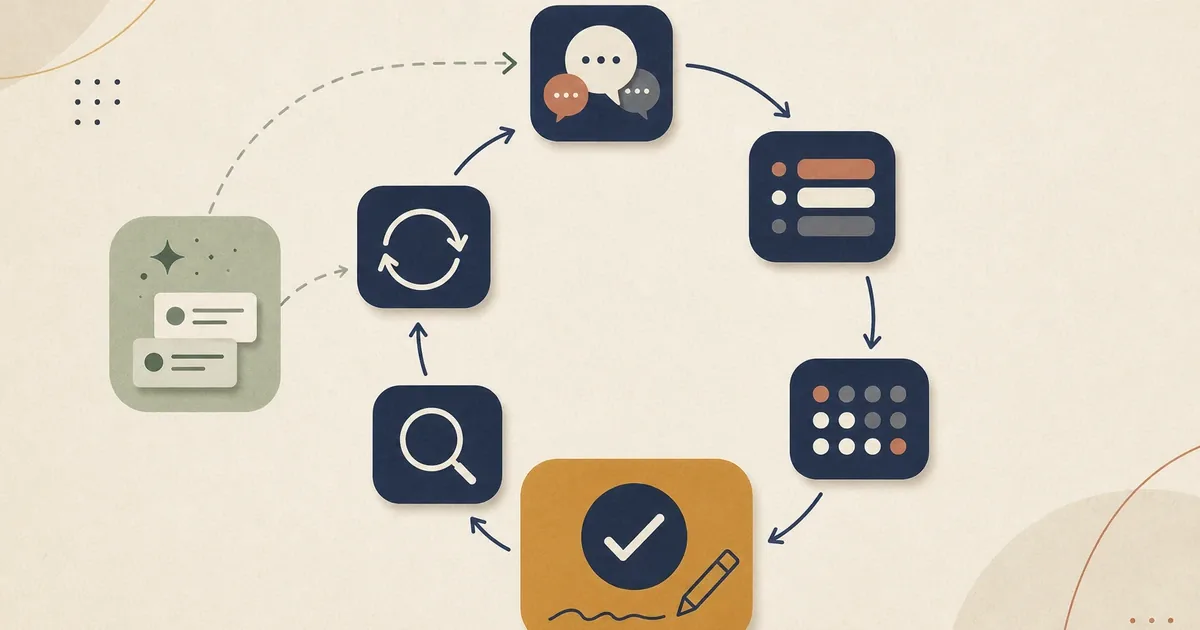
Run a human-controlled refinement loop
A repeatable loop makes AI assistance easier to inspect. It also makes it easier to stop using the tool when it adds little value.
- Prepare a bounded packet of current information and label assumptions clearly.
- Ask for candidates: questions, alternative splits, observable conditions, and counterexamples.
- Challenge the output against source material and the knowledge of the people in the room.
- Discuss choices that affect value, scope, order, feasibility, or risk.
- Update the Product Backlog with what the team decided instead of pasting in the model's text.
- Check whether the item now has enough transparency for the next conversation, including possible Sprint Planning.
AI comes before the decision, not in place of it. The Product Owner can use a clearer item for ordering decisions. Developers use refined information to discuss feasibility and sizing. Stakeholders and domain specialists test whether the language reflects reality.
Keep a light record of important changes: which question changed the item and which uncertainty remains. This keeps the decision trail visible when AI-generated refinement material becomes part of an item.
Where this fits in the Product Owner AI workflow
AI-assisted refinement sits between upstream learning and detailed work on near-term Product Backlog items. It does not replace customer research or serve as a tools catalog.
A Product Owner also needs a wider approach for deciding where AI helps and protecting accountability. The Product Owner AI tools overview can help when selecting or evaluating tool categories. Use this guide when a known product concern needs to become a clearer Product Backlog conversation and the decision is still with people.
For Product Owners who want structured practice with these boundaries, the Professional Scrum Product Owner - AI Essentials course is a related training option. The guide's discipline is simple: give bounded context, inspect every candidate, and keep human accountability where Scrum places it.
Frequently asked questions
Keep learning
Guide
AI for Product Owners: A Method for Better Daily Decisions
A four-step method for accountable AI-assisted Product Owner decisions: frame the decision, bound the context and data, challenge the output, validate evidence and decide.

Reference
Evidence-Based Management for Product Owners
Evidence-Based Management connects organizational direction to measurable outcomes. This guide helps Product Owners use leading and lagging indicators and the four Key Value Areas to turn evidence into product decisions.

Guide
Product Discovery with AI: Techniques for Modern Product Teams
Use AI in product discovery to prepare research, synthesize customer evidence, explore opportunities, and generate testable assumptions while keeping customer interviews, validation, and human judgment at the center of every decision.
Ready to go beyond the guide?
Take the next step with hands-on Professional Scrum training led by an experienced trainer.