How to Pass the PSPO-AI Essentials Certification Exam
PSPO-AI Essentials validates your knowledge of applying AI within Product Ownership. Learn exam structure, focus areas, study resources, and preparation strategies from official Scrum.org materials.
On this page
Last reviewed:
What This Resource Covers
Use this resource to understand how Scrum.org frames AI for Product Owners, where the exam draws the line between tool use and judgment, and how to prepare without turning the topic into generic AI study.
What Is PSPO-AI Essentials?
According to Scrum.org, the PSPO-AI Essentials certification validates your knowledge of applying Artificial Intelligence within the scope of Professional Scrum Product Ownership. It demonstrates the ability to explore, evaluate, and integrate AI tools and practices to enhance product discovery, customer understanding, experimentation, and decision-making in a responsible and ethical manner.
The exam stays anchored in Product Ownership. It looks at how AI changes discovery, experimentation, decision-making, and responsible product work inside the Product Owner accountability.
Exam Details
- Cost: $200 USD per attempt
- Passing score: 85%
- Time limit: 60 minutes
- Questions: 40
- Format: Multiple choice
- Language: English
- Digital badge: Free Credly credential included
- Retake policy: 14-day waiting period after first failed attempt
That means you need at least 34 correct answers and can miss at most 6 questions.
You have about 90 seconds per question on average. The pace is more forgiving than PSPO I, but that can make overthinking its own trap.
Test passwords never expire. You can purchase one and take the exam whenever you are ready.
Focus Areas
The exam is organized around three categories defined by Scrum.org. Use these as your study map. They tell you exactly what topics will appear.
AI Theory and Primer
- Foundational AI concepts: machine learning, deep learning, generative AI, agentic AI
- How AI supports modern product development
- Key terminology and the AI landscape for Product Owners
The emphasis is on understanding what each type of AI means for product work, not on technical depth. You do not need to know how to build or train models.
AI Security and Ethics
- Responsible and ethical AI adoption
- Security considerations when integrating AI tools
- Impact of AI on the Definition of Done
- Organizational policies and governance for AI use
This category reflects the growing importance of governance in AI adoption. Be prepared for questions that test your understanding of responsible AI use from a Product Owner's perspective, not from a legal or compliance angle.
A useful way to study this area is to ask where AI affects trust, release quality, customer data, or team decisions. Those are Product Owner concerns, not side topics.
AI Product Ownership
- Using AI to enhance product discovery and customer understanding
- AI-assisted experimentation and validation
- Leveraging AI for value-driven decision-making
- Integrating AI tools into daily Product Ownership practices
- The evolving stances of the AI-literate Product Owner
This is the core of the exam. Questions here focus on practical application: how a Product Owner can use AI tools to discover customer needs, run experiments, make better decisions, and manage the Product Backlog more effectively.
The exam is not asking whether you know the latest tool names. It is checking whether you can judge when AI use improves product work and when it adds noise, risk, or shallow output.
How to Prepare
Step 1: Take the Product Owner AI Open Assessment First
Before you study anything, take the free Product Owner AI Open assessment. This gives you a baseline of where you stand. Scrum.org describes it as a tool for validating your understanding and creating a baseline from which you can start improving immediately.
A critical point: the Open assessment questions are not at the same difficulty level as the real certification exam. Use it to identify which of the three categories you already know and which need work, but do not assume that scoring well on the Open means you are ready for the real exam.
Step 2: Study Each Category Systematically
Use the three focus areas as your study plan. For each category, Scrum.org publishes free blog articles by Professional Scrum Trainers that explain the exact concepts the exam tests.
AI Theory and Primer — Start with these two articles from the Scrum.org blog:
- AI, Machine Learning, Deep Learning, and Generative AI: A Plain-English Guide for Scrum Teams covers the core concepts (AI, ML, deep learning, generative AI) in the context where a Product Owner works.
- AI Categories — Capability (ANI, AGI, ASI) explains the different capability levels of AI, including agentic AI.
- AI Categories — Functionality covers reactive, limited memory, theory of mind, and self-aware AI categories.
Focus on understanding what each type of AI means for a Product Owner's work, not on technical definitions. These articles are written specifically for a Scrum audience.
AI Security and Ethics is the category most candidates underestimate. Scrum.org resources to study:
- Read the Professional Scrum Product Owner - AI Essentials course page carefully. It gives useful context for the AI-literate Product Owner stance and the security and ethics angle behind the certification.
- How is the Data on the Internet Used to Train AI Models explains how training data works, which feeds directly into questions about responsible AI adoption and data governance.
- Think through how AI impacts the Definition of Done and what governance means at the team level, not just at the organizational level.
AI Product Ownership is the core of the exam. These Scrum.org blog articles show concrete applications of the concepts you will be tested on:
- NotebookLM & Product Owners is a practical walkthrough of using an AI tool for product discovery and customer understanding.
- Measuring the Value of AI covers value-driven decision-making with AI, avoiding measurement traps, and evaluating AI's impact.
- Fixing Your OKRs Using AI shows how AI assists with product management and strategic decision-making.
- AI Transformation for Scrum Teams (Step 1) provides a framework for integrating AI into team workflow, relevant to Backlog management and team collaboration.
Browse the full Scrum.org blog with the AI tag for additional articles. The key is to understand how AI concepts apply in practice, not memorise facts.
Step 3: Retake the Open Assessment
After studying each category, retake the Open assessment. Track your score per category to see where you have improved and where you still need work. Repeat until you consistently score in all three areas.
Review misses by category, not just by total score. If the weak area is terminology, go back to the primer material. If the weak area is governance or Definition of Done implications, go back to security and ethics. If the weak area is discovery, experimentation, or value, go back to Product Ownership use cases.
Step 4: Review the Scrum Guide
PSPO-AI Essentials assumes familiarity with the Scrum framework and the Product Owner accountability. The Scrum Guide remains the foundation. If you are new to the Product Owner role, read the Scrum Guide before studying AI-specific content, focusing on the Product Owner accountability section.
Step 5: Consider the Training Course
Agile Way offers the Professional Scrum Product Owner - AI Essentials course. It is a one-day, hands-on class delivered by a Professional Scrum Trainer that covers all three exam categories through exercises with AI tools. Attendance is not a prerequisite for the exam, but it can help you prepare with structure and feedback. The course includes a free exam attempt in the price.
Exam Strategy
You have 60 minutes for 40 questions. With an 85% passing threshold, you can miss at most 6 questions.
- Pace yourself. You have about 90 seconds per question. This is more generous than many Scrum.org exams, but it can lull you into spending too long on individual questions. If a question takes more than two minutes, flag it and move on.
- Read the stem carefully. The wording in AI-related questions can be subtle. Watch for words like "ethical," "responsible," "secure," or "compliant," they signal which angle the question is testing.
- Watch for the ethics angle. The AI Security and Ethics category is one of three exam areas. If a question mentions governance, responsible use, or the Definition of Done, it is likely testing this category.
- Think like a Product Owner, not an AI specialist. The correct answer is the one that maximizes value responsibly, not the one that is most technically advanced. If an option sounds like something an engineer would say rather than a Product Owner, set it aside.
- Practice timing with the Open assessment. Use it to get a feel for how long each question type takes you.
What Comes After Passing
Once you pass, you receive a Credly digital badge. Like all Scrum.org certifications, it is valid for life with no renewal fees.
Related certifications to consider:
- PSPO I, foundational certification for the Product Owner accountability
- PSPO II, advanced certification for experienced Product Owners
- PSM-AI Essentials, for applying AI from a Scrum Master perspective
- Product Discovery and Validation, for deepening experimentation and customer research skills
Related Training
Agile Way offers public and private Professional Scrum Product Owner - AI Essentials courses. The course gives you structured preparation and hands-on experience with a Professional Scrum Trainer.
Summary
PSPO-AI Essentials covers three categories defined by Scrum.org: AI Theory and Primer, AI Security and Ethics, and AI Product Ownership. The most effective preparation strategy is:
- Start with the Open assessment to find your baseline
- Study each category systematically using the focus areas as your guide
- Retake the Open assessment to track progress
- Review the Scrum Guide for foundational Product Owner knowledge
- Consider the recommended training course for hands-on practice
Frequently asked questions
Keep learning
Guide
PSPO I or PSPO-AI Essentials: Which Course Should You Choose?
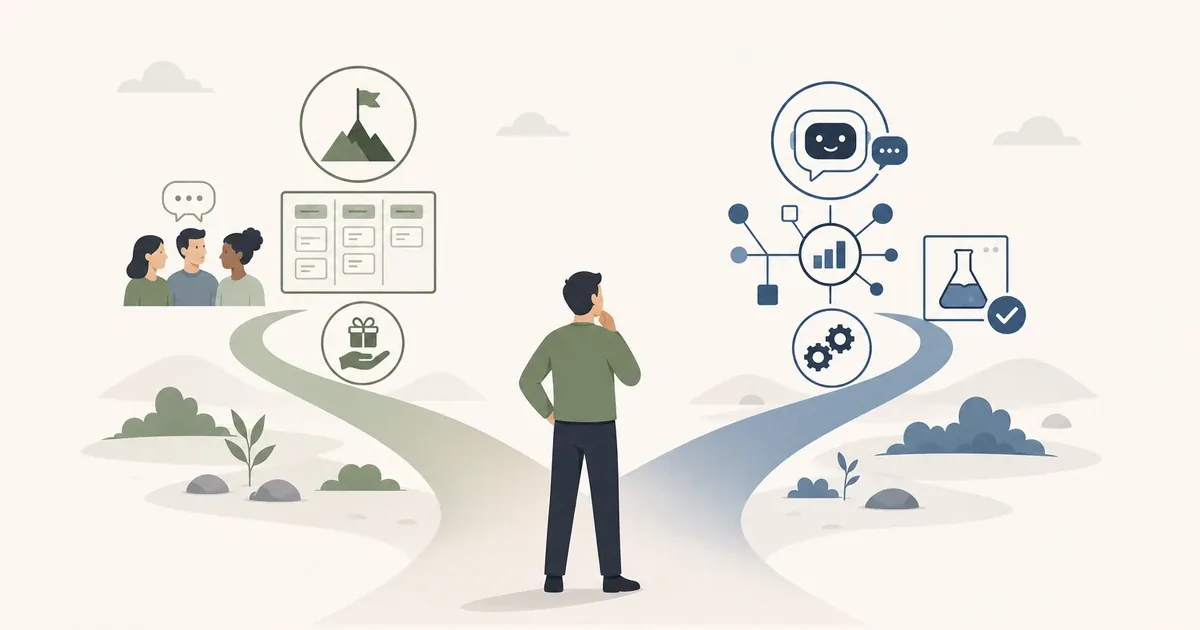
PSPO I develops the broader Product Owner accountability in Scrum. PSPO-AI Essentials concentrates on using AI in product work. This comparison explains when each course fits and why some people benefit from taking both.

Guide
Product Owner AI Tools: A Practical Overview for 2026
An accountability-first overview of AI tools for Product Owners. Compare tools by the work they support, protect source material, and test one workflow in 30 minutes.

Guide
How to Pass the PSPO II Certification Exam
A study plan for the PSPO II assessment covering exam structure, recommended resources from Scrum.org, focus areas, and common mistakes.
Ready to go beyond the guide?
Take the next step with hands-on Professional Scrum training led by an experienced trainer.